

Texas School Vouchers: Who Benefits, Who Doesn't, and Why It Matters
Updated: Nov 10, 2025
In our last post, Understanding Texas Senate Bill 2 (SB2): Educational Savings Accounts, we explained how the bill structures eligibility, funding, and oversight of the new ESA program. In this follow-up, we examine the most common criticisms of school vouchers—who really benefits, what the risks are to public schools, and how SB2 does or doesn't respond.
Think SB2 Supports Your Stance on Vouchers and Public Schools? You Might Be Right - Or Not. Here's What the Actually Law Does
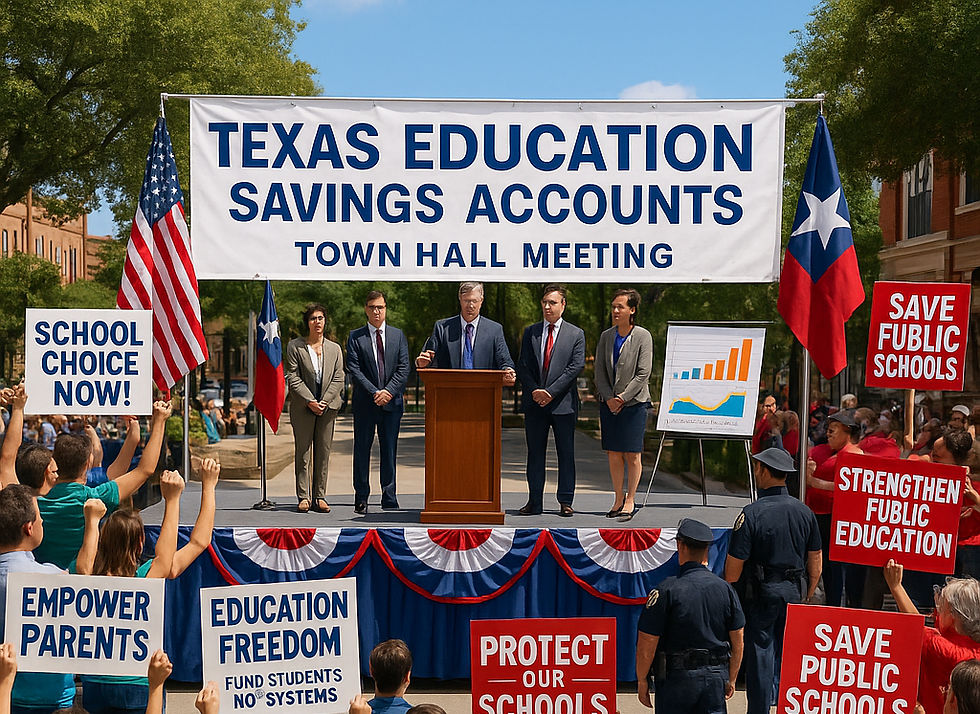
While there was significant debate, Senate Bill 2 (SB 2) establishing the ESA program was signed into law by Governor Greg Abbott on May 3, 2025, culminating a years-long effort. The Comptroller's office is now tasked with creating the program and finalizing rules by May 15, 2026, with applications expected to open for the 2026-2027 school year.
Critics argue that rather than expanding opportunities for disadvantaged students, the proposed voucher system may primarily serve as a subsidy for wealthy families while undermining public schools that most Texas children depend on.
Let's examine what critics are saying, what the actual bill provides, and what it all means for different types of families.
What Critics Say: Does the Voucher Program Favor the Wealthy and Harm Low-Income Families?
A Subsidy for Families Who May Not Need Financial Assistance
One of the strongest criticisms of SB2 is that it provides taxpayer-funded vouchers to families who don’t need financial help and are already paying for private education. Evidence from other states supports these concerns:
Arizona: 75% of voucher applicants were children already attending private school
Florida: 69% of new universal ESA funds went to students who were already privately enrolled
Texas projections: The fiscal analysis for SB 2 anticipates that 175,000 students already in private school would apply in the first year, compared to only 24,500 students leaving public schools
This means the majority of voucher funds could go to families already paying for private education, effectively providing them with a taxpayer-funded discount.
Broad Definition of Who Qualifies as "Low-Income"
The Texas bill's eligibility criteria are surprisingly broad. Up to 20% of the initial $1 billion budget could go to families earning at or above 500% of federal poverty guidelines (FPGs), which is roughly $160,000 or more for a family of four. While families earning over $100,000 are included in the broad "low-income" definition of SB 2 (up to 500% FPG or $160,000 for a family of four), they are not prioritized equally.
This means that families earning over $100,000 annually would fall into the third or fourth tiers, meaning lower-income families would generally receive priority. The bill establishes a tiered priority system if demand exceeds funding:
Students with disabilities from families at or below 500% FPG.
Families at or below 200% FPG (around $62,400).
Families between 200% and 500% FPG.
Families at or above 500% FPG, who are the lowest priority group.
Voucher Amounts May Not Cover Full Tuition
The typical ESA amount in Texas would be roughly $10,000 to $10,900 per student, with up to $30,000 available for students with special needs. However:

Private school tuition in Texas averages over $11,000
Elite institutions can charge up to $40,000
Special education schools cost around $19,000
Even with voucher assistance, lower-income families would still need to cover significant costs that may remain prohibitive. Additionally, "school choice" doesn't guarantee "parent choice" since private schools can set their own admissions policies and aren't required to accept all students.
Potential Harm to Public Schools and Students Who Remain
Critics argue that vouchers will cause significant harm to the public school system, particularly affecting students from low-income families:
Funding Structure Problems:
Texas already ranks 46th nationally in per-pupil funding
The state spends over $5,000 less per student than the national average
When students leave for private schools using vouchers, public school districts lose per-pupil funding
Fixed costs like teacher salaries and building maintenance remain the same
This forces public schools to implement budget cuts, reduce programs, increase class sizes, or lay off staff
Limited Oversight for Taxpayer Funds
Unlike public schools, private schools receiving voucher funds aren't subject to the same regulations and transparency requirements:
No requirement to administer state standardized tests like STAAR, though they are required to administer a nationally recognized norm-referenced test for grades 3-12
No requirement to follow the same grievance policies
Less democratic oversight compared to public schools with elected boards
Some argue that there is no mandated transparency about curriculum or teacher certification. This is partially accurate. Here are the details:
Private schools receiving funds are not required to follow state curriculum standards or teacher certification requirements in the same way as public schools
However, the bill does outline qualifications for individual private tutors, therapists, or teaching services to be preapproved, including certain educator qualifications, licenses, or criminal history record reviews
Worsening Inequities Across Texas
The voucher program may worsen existing educational inequities:

Rural Communities:
Fewer private school options are available
Will still experience public school funding cuts
Gain no new educational choices, at least initially
Special Education Students:
Private schools aren't obligated to follow federal special education laws
No requirement to provide Individualized Education Programs (IEPs)
Despite higher voucher amounts, services and protections may be reduced
Private schools are not obligated to follow federal special education laws or IEPs; though they may choose to do so
An important note on Special Education and students currently homeschooled or enrolled in private schools: Before Senate Bill 2, there was a mechanism for parents of children not currently in public school to request a full individual and initial evaluation (FIE) from their local school district to determine their child's eligibility for special education services and, if eligible, to develop an Individualized Education Program (IEP). This will continue to be the case under SB2. This will be important for establishing eligibility for the ESA program as a child with a disability. This is an important provision for families seeking to qualify for the higher ESA amount for students with disabilities.
Mixed Results from Other States
Research from other states with voucher programs offers limited encouragement. Studies from Florida and Wisconsin have shown mixed or even negative academic outcomes for students who use vouchers, particularly low-income students. While some research suggests public schools facing voucher competition may improve slightly, these effects are often small compared to what could be achieved through direct investments in public education.
What the Bill Actually Says: Addressing or Not Addressing the Concerns
To fairly assess these criticisms, let's examine how the actual bill text (S.B. No. 2) addresses or fails to address each concern.
Does the Program Prioritize the Wealthy?
Critic Concern Status: Partially Addressed
The bill includes some protections but doesn't fully prevent wealthy families from benefiting:
What the Bill Does:
Requires priority for students enrolled in public schools for at least 90% of the preceding year
Caps spending for highest-income families (500%+ of federal poverty guidelines) at 20% of the total budget ($200 million)
Creates a tiered priority system favoring lower-income families
What It Doesn't Do:
Doesn't prevent students already in private schools from applying
Still allows "wealthy" families to access funds, just at a lower priority
Are Families Making $160K+ Still Eligible?
Critic Concern Status: Confirmed by Bill
Yes, families earning at or above 500% of federal poverty guidelines (roughly $160,000+ for a family of four) remain eligible. While they're designated as the lowest priority group, the bill explicitly allows up to 20% of each year's budget to go to these families.
Can Low-Income Families Afford Private School Even with Vouchers?
Critic Concern Status: Confirmed by Bill
The bill confirms that ESAs may not cover all private school costs. It states that parents "may make payments for the expenses of educational programs, services, and products not covered by money in the account." This directly confirms that families must cover any remaining costs, supporting concerns that the program doesn't work for truly low-income families.
Will Public Schools Lose More Than They Gain?
Critic Concern Status: Legitimate Concern Remains
While the bill specifies that ESAs cannot be funded using certain dedicated public school funding sources, it is funded through the general revenue fund, which is a primary source of state funding for public schools. Money appropriated for ESAs could otherwise be allocated to public schools.
Important Detail: The bill includes a minor incentive for public schools when students return (an additional 0.1 basic allotment), but this doesn't offset the full per-pupil funding loss.
What Oversight Will Private Schools Face?
Critic Concern Status: Partially Addressed
The bill includes some accountability measures but leaves gaps:
Academic Oversight:
Requires nationally norm-referenced assessments or state assessments for grades 3-12
Mandates annual reporting of results
Financial Oversight:
Annual audits of accounts and eligibility data
State auditor reviews 10% of applications
Private schools must provide proof of third-party financial audits
Remaining Gaps:
No requirement for state curriculum standards
There are no specific teacher certification requirements, but the bill does set qualifications for individual private tutors, therapists, or teaching services to be "pre-approved education service providers"
Private schools retain full autonomy over instruction methods
There is no elected oversight like public schools have for private schools
Are Rural and Special Needs Students Protected?
Critic Concern Status: Mixed Results
Rural Students:
The bill includes no provisions to create private school options in underserved rural areas
Rural families may see public schools harmed without gaining new choices
Special Education Students:
Bill allows up to $30,000 for students with disabilities
However, requires written notice that "private schools are not subject to federal and state laws regarding the provision of educational services to a child with a disability"
Confirms private schools aren't bound by federal special education laws or required to provide IEPs
Is the Loss of Local Accountability a Real Concern?
Critic Concern Status: Confirmed by Bill
The bill explicitly states that education service providers receiving program money are "not considered to be a state actor on the basis of receiving that money." This deliberately removes private schools from the direct governmental oversight and democratic accountability that applies to public schools.
Which Concerns Are Real? A Quick Guide
Concerns the Bill Clearly Addresses:
Financial fraud and misuse through auditing requirements
Academic measurement through required assessments
Priority systems that favor lower-income families over higher-income ones
Concerns the Bill Doesn't Fully Address:
Fund diversion from public schools
Guaranteed access to private schools
Full cost coverage for low-income families
Rural equity and access
Democratic accountability for taxpayer funds
Concern | Status | Bill Response |
Primarily benefits wealthy families | Partially valid | Families of 4 earning $160K+ are considered "wealthy" and are at the bottom of the priority structure, but are still eligible |
Broad income eligibility | Confirmed | Families earning $160K+ are explicitly allowed (but a max of 20% of the program budget can go to these families) |
Insufficient funding for poor families | Confirmed | Bill acknowledges that families must cover the remaining costs when tuition exceeds the funding provided |
Private school admissions discretion | Confirmed | Schools explicitly granted full autonomy over admissions |
Public school funding loss | Valid concern | Funded from general revenue that could go to public schools |
Limited accountability | Partially addressed | Some auditing/testing required, but less oversight than public schools |
Rural inequity | Unaddressed | No provisions for creating rural private school options |
Special education concerns | Confirmed | Private schools are explicitly not bound by federal special ed laws, but students eligible for an IEP are entitled to additional funding |
Loss of democratic oversight | Confirmed | Private schools are explicitly exempted from state actor requirements |

The Bigger Picture
The Texas ESA law includes some real safeguards, but many of the concerns raised by critics still stand. The way the program is structured means it is more likely to support families who already have access to private options, while it may weaken the public schools that serve most students.
This post focused on the critics' perspective. Next, we’ll look at why many families and advocates support school choice and whether SB2 lives up to those expectations.
Understanding both the benefits and the limits of this program is key to making informed decisions for your family.
Have questions about how SB2 might affect your family or educational organization? Contact us, follow us on Facebook, Instagram, or subscribe to our newsletter for the latest updates and insights.
References
Cave, T. (2025, April 4). House Public Education Committee advances voucher bill, school finance. Teach the Vote.
Edison, J. (2025, March 4). Texas' vouchers might not help low-income kids, experts say. The Texas Tribune.
Edison, J. (2025, May 3). Private school vouchers are now law in Texas. Here's how they will work. The Texas Tribune.
Gainey, B. (2025, May 2). Amid cheers and protests, Gov. Abbott signs $1 billion Texas school voucher bill into law. KUT Radio.
Garcia, X. (2025, March 9). How will ESAs, or education savings accounts, work in Texas? San Antonio Report.
McNeel, B. S. (2025, March 27). Are School Vouchers Really "Welfare for the Wealthy"? Texas Monthly.
Nittle, N. (2025, April 18). How the $1 billion Texas school voucher program could have a nationwide ripple effect. The 19th.
S.B. No. 2 AN ACT relating to the establishment of an education savings account program. (2025). Texas Legislature.
Texas AFT. (2024, December 5). How Vouchers & Charter Schools Hurt Public School Funding: A Q&A with Dr. David Knight & Dr. David DeMatthews. Texas AFT.
Texas AFT. (2025, July 10). Public Education at a Crossroads: Vouchers, Cuts, and the Fight Ahead. Texas AFT.

