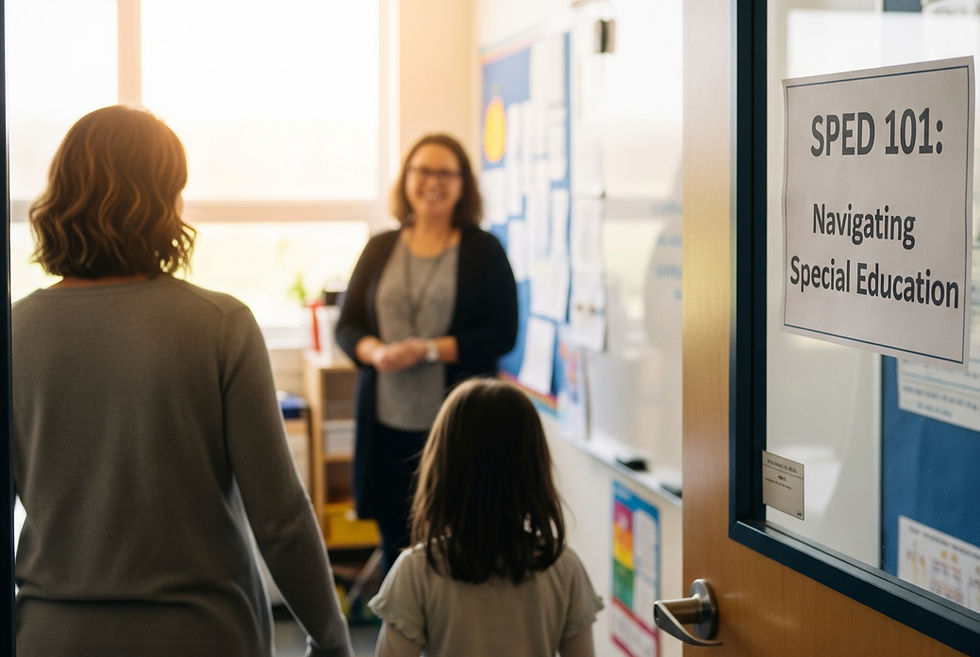
What Is Special Education? Building Access, Support, and Opportunity for Every Learner
Updated: Aug 24, 2025
Welcome to the first installment of our SPED 101 series, created to help families and educators better understand the process, purpose, and power of special education. Whether you're new to these terms or already navigating the special education system, this series is here to equip you with knowledge and clarity.
Let’s begin with the foundation.
What Does “Special Education” Really Mean?
At its core, special education refers to specially designed instruction that meets the unique needs of a child with a disability. It is not a one-size-fits-all approach. Instead, it’s a customized support system meant to give every child an equal opportunity to learn and thrive.
This right is protected by a federal law called the Individuals with Disabilities Education Act (IDEA). IDEA ensures that eligible students with disabilities receive what is known as a Free Appropriate Public Education (FAPE). This includes access to both special education services and related services, designed to support the child's academic and functional development.
The Purpose Behind Special Education
The purpose of special education is not simply to offer additional help. It is to ensure that children with disabilities can be involved in and make progress through the general curriculum. That might mean learning at a different pace, using specialized tools or strategies, or receiving focused instruction in specific areas.
Ultimately, special education is meant to help students prepare for:
Further education
Employment
Independent living
Special Education vs. Related Services
You might hear both terms used together, and while they often work hand in hand, they are not the same thing.
Special education is the core instruction designed to meet a child's unique learning needs.
Related services are supports that help the child benefit from that instruction.
These can include services such as:
Speech-language therapy
Occupational or physical therapy
Counseling
Orientation and mobility training
Transportation to and from school or specialized programs
Think of special education as a custom-built ramp leading into a multi-story building that represents the general curriculum. The ramp doesn’t replace the building—it makes it accessible. Related services are the handrails and lighting that make sure the ramp is safe, supportive, and usable.
Who Qualifies?
To receive special education, a student must meet two specific criteria:
The student must have a disability recognized under IDEA. These include conditions such as autism, speech or language impairments, emotional disability, intellectual disabilities, and others.
The disability must create a need for special education and related services. In other words, it must significantly affect the student’s ability to benefit from education without specialized instruction.
It’s important to know that not every struggling learner is eligible. A child’s difficulties must not be primarily due to a lack of appropriate instruction in reading or math or due to limited English proficiency.
What Is an IEP, and Who Creates It?
In Texas, the planning and decision-making for a student’s special education services are handled by the Admission, Review, and Dismissal (ARD) committee. Federally, this is called the IEP (Individualized Education Program) team.
This group includes educators, specialists, and, importantly, parents. The ARD committee:
Determines eligibility
Develops and reviews the student’s Individualized Education Program (IEP)
Decides on the child’s educational placement
The IEP is a formal plan that outlines the student’s strengths, goals, services, and accommodations. It is the blueprint for ensuring FAPE and is reviewed regularly to make sure the student is making progress.
The Role of Parent Consent
Before any special education services can begin, the school must have written parental consent. If a parent declines or later withdraws consent, the school cannot provide services, even if the child remains eligible. This gives families an essential role in shaping their child’s educational experience from the very beginning.
Looking Ahead
We've laid the groundwork for what we’ll explore in the SPED 101 series. In the next post, we’ll take a closer look at how children are identified for special education and the school’s legal responsibility to find and evaluate students who may need support.
Together, we’ll continue to unpack the process, one step at a time, so you can feel confident, informed, and ready to advocate for every child’s right to learn.