

Does My Child Qualify? Understanding Section 504 Eligibility
One of the most important questions parents ask is: "Does my child qualify for Section 504 protections?" The answer depends on whether your child meets the legal definition of having a disability under Section 504. This is part 2 of our Understanding Section 504 series, where we will help you understand the eligibility criteria and what they mean for your child.
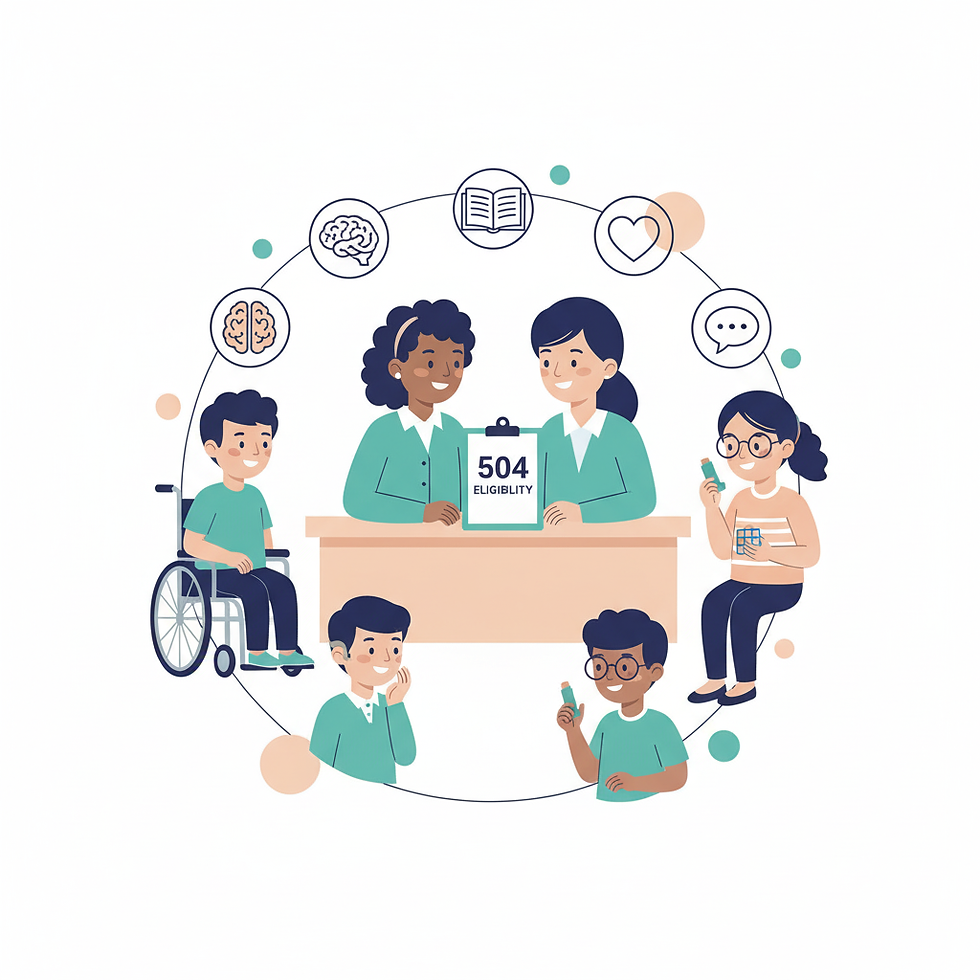
The Three-Part Definition of Disability
Under Section 504, a person is considered to have a disability if they meet one of three criteria:
Has a physical or mental impairment that substantially limits one or more major life activities, OR
Has a record of such an impairment, OR
Is regarded as having such an impairment
Most students who receive Section 504 services in elementary and secondary schools qualify under the first criterion. They have a current impairment that substantially limits a major life activity and need services because of that disability.
Let's break down each component of this definition.
What Counts as a Physical or Mental Impairment?
The definition of impairment under Section 504 is broad. It includes:
Physical impairments: Any physiological disorder, condition, cosmetic disfigurement, or anatomical loss affecting body systems such as:
Neurological systems
Respiratory systems
Cardiovascular systems
Endocrine systems
Digestive systems
And other major body systems
Mental or psychological impairments, including:
Intellectual disabilities
Emotional illness
ADHD (Attention Deficit Hyperactivity Disorder)
Organic brain syndrome
Examples of conditions that may constitute impairments include:
Orthopedic, visual, speech, and hearing impairments
Cerebral palsy, epilepsy, muscular dystrophy, multiple sclerosis
Cancer, heart disease, diabetes
ADHD
HIV infection (whether symptomatic or asymptomatic)
Tuberculosis
Emotional and mental health conditions
Drug addiction and alcoholism (with some limitations regarding current illegal drug use)
Having one of these conditions doesn't automatically mean your child qualifies for a Section 504 Plan. The impairment must substantially limit a major life activity.
What Are Major Life Activities?
This is crucial: Major life activities are not limited to learning. The list of major life activities is extensive and includes:
General activities:
Caring for oneself
Performing manual tasks
Walking
Seeing
Hearing
Speaking
Breathing
Learning
Working
Concentrating
Reading
Thinking
Communicating
Standing
Lifting
Bending
Eating
Sleeping
Major bodily functions:
Functions of the immune system
Normal cell growth
Neurological functions
Brain functions
Respiratory functions
Circulatory functions
Endocrine functions
Reproductive functions
Why this matters: Your child can be eligible for Section 504 services even if the disability does not limit the major life activity of learning. For example, a child with severe diabetes might qualify because the condition substantially limits the major bodily function of their endocrine system, even if they are performing well academically.
Understanding "Substantial Limitation"
The determination of whether a major life activity is substantially limited must be made on a case-by-case basis. There's no one-size-fits-all answer. The Section 504 Team looks at how your child's impairment affects them specifically.
A substantial limitation means the impairment restricts the condition, manner, or duration in which your child can perform a major life activity compared to most people in the general population.
Important Considerations:
It's not about comparison to other students with the same diagnosis. The question is whether your child is substantially limited compared to the general population, not compared to other students with ADHD, diabetes, or any other specific condition.
Episodic or remitting conditions count. If your child has an impairment that is episodic (like epilepsy) or in remission (like cancer), they are considered to have a disability if the impairment would substantially limit a major life activity when active.
Severity matters. The impairment must be more than a minor or temporary limitation. Courts and schools look at the nature and severity of the impairment, how long it has lasted or is expected to last, and its permanent or long-term impact.
The Critical Role of Mitigating Measures
This is one of the most misunderstood aspects of Section 504 eligibility, and it's crucial for parents to understand.
When determining if your child's impairment substantially limits a major life activity, the school district must NOT consider the beneficial effects of any mitigating measures your child uses.
Mitigating measures include:
Medication
Medical devices or appliances (except ordinary eyeglasses or contact lenses)
Learned behavioral or adaptive neurological modifications
Assistive technology
Reasonable accommodations or auxiliary aids
What This Means in Practice:
If your child takes medication for ADHD and functions well with the medication, the school must evaluate whether your child would be substantially limited without the medication. The question is: Would your child be substantially limited in their unmitigated state?
Example: Your child has ADHD and takes medication that helps them focus and complete tasks. When determining eligibility, the Section 504 Team must consider how your child's ADHD would impact them if they were not taking the medication. If the ADHD substantially limits concentrating, learning, or reading without medication, your child has a disability under Section 504, even though the medication is currently effective.
The only exception: Ordinary eyeglasses or contact lenses. The ameliorating effects of regular corrective lenses can be considered.
Why this matters: This requirement ensures that students who successfully manage their disabilities with medication or other supports are still recognized as having disabilities and can receive the accommodations they need at school.
Can My Child Qualify Even If They're Doing Well Academically?
Yes, absolutely. This is a critical point that many schools and parents misunderstand.
A student can have a high GPA, earn good grades, and still qualify for Section 504 protections. Academic success does not automatically mean a student doesn't have a substantially limiting impairment.
Consider these scenarios:
A student with ADHD who maintains a 3.5 GPA but must study for extraordinarily long hours each night to achieve those grades, far exceeding the time their peers spend
A student with anxiety who earns good grades but experiences panic attacks that substantially limit their ability to concentrate or interact with peers
A student with diabetes who performs well academically but whose endocrine function is substantially limited, requiring frequent monitoring and intervention
If a school suspects your child has a disability (based on observable behaviors, parental reports, or other information), they have a duty to evaluate, even if your child is academically successful.
What About a Medical Diagnosis?
Here's what parents need to know about medical diagnoses and Section 504 eligibility:
A medical diagnosis alone is not enough to qualify for Section 504 services. Having a doctor's note that says your child has ADHD, diabetes, or anxiety does not automatically entitle your child to a 504 Plan.
However, a medical diagnosis is important data. A physician's medical diagnosis may be considered among other sources in the evaluation process. If the Section 504 Team determines that a medical assessment is necessary to conduct the evaluation and establish the disability, the school district must ensure your child receives this assessment at no cost to you.
The school must look at the whole picture. The Section 504 Team must draw from a variety of sources, including aptitude and achievement tests, teacher recommendations, your child's physical condition, social and cultural background, adaptive behavior, and input from you, your child, and other professionals.
Two questions must be answered:
Does your child have an impairment that substantially limits a major life activity?
Does your child need regular or special education and related aids and services because of that disability?
Both questions must be answered "yes" for your child to receive a Section 504 Plan and FAPE.
"Record Of" or "Regarded As" Having a Disability
Students who meet the definition of disability solely because they have a "record of" a disability or are "regarded as" having a disability are protected from discrimination under Section 504's general nondiscrimination requirements.
However, these students are generally not entitled to receive FAPE (and thus, typically not a Section 504 Plan) in public elementary and secondary schools. They are protected from harassment, bullying, and discriminatory treatment based on disability, but they don't automatically receive accommodations or services.
The Bottom Line on Eligibility
To qualify for Section 504 protections and services (FAPE), your child must:
Have a physical or mental impairment
That substantially limits one or more major life activities (evaluated in the unmitigated state, without considering the beneficial effects of medications or supports)
AND need regular or special education and related aids and services because of that disability
The determination must be made on an individualized, case-by-case basis by a knowledgeable team using a variety of data sources.
Remember: The definition of disability under Section 504 is intentionally broad. Many students who don't qualify for special education under IDEA may still qualify for protections and accommodations under Section 504.
Next in this series: Section 504 vs. Special Education (IDEA) - Understanding the Difference
Need Help From a Section 504 Parent Advocate to Determine if Your Child May Qualify?
Accessible Education can review the details of your situation and help you identify next steps. Learn more about our Special Education and Section 504 Advocacy Services or request a free consultation.


