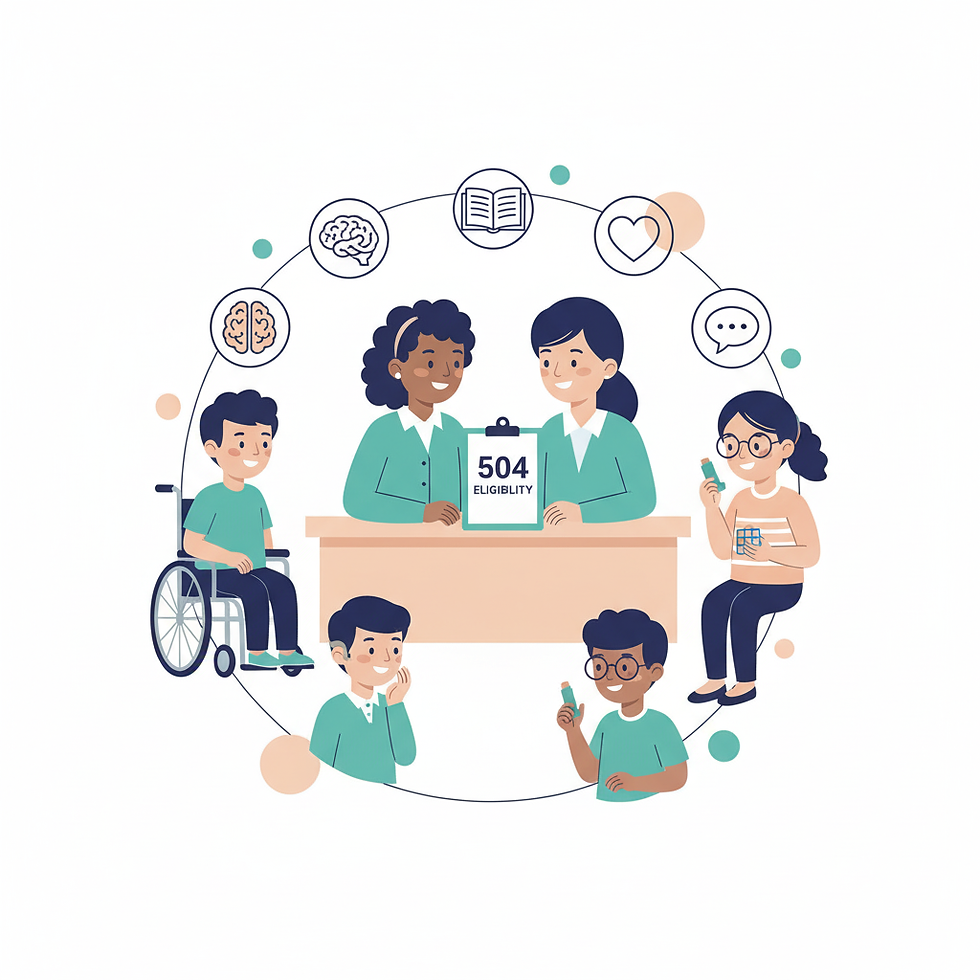
The Section 504 Plan: Your Child's Educational Blueprint

Once your child has been evaluated and found eligible for Section 504 protections, the next step is creating a Section 504 Plan. This document serves as the roadmap for how your child's educational needs will be met. Understanding what goes into this plan, how it's developed, and what it means for your child is essential to ensuring they receive appropriate support.
What is a Section 504 Plan?
A Section 504 Plan is an individualized document that schools typically use to document the services necessary to provide your child with a Free Appropriate Public Education (FAPE).
Purpose of the Plan
The plan serves as an educational blueprint designed to meet the unique needs of your child and provide them access to FAPE. An appropriate education is one designed to meet the individual needs of students with disabilities as adequately as the needs of their non-disabled peers are met.
Is a Written Plan Required?
Interestingly, federal Section 504 regulations do not explicitly require a written plan. However, practical requirements make documentation necessary. A written plan is essential for:
Communicating necessary information to school personnel
Avoiding misunderstandings about the services offered
Ensuring consistent implementation across all staff
Providing clear documentation of the school's commitment to FAPE
Because of these practical needs, schools routinely create written Section 504 Plans, and you should expect your child to have one.
What Should Be Included in a Section 504 Plan?
A comprehensive Section 504 Plan typically includes several key components:
1. Description of the Physical or Mental Impairment
The plan should clearly identify your child's disability. This helps all staff understand the basis for the accommodations.
Example: "Student has been diagnosed with Attention Deficit Hyperactivity Disorder (ADHD), predominantly inattentive type."
2. Major Life Activities Substantially Limited
The plan must list which major life activities are substantially limited by your child's impairment. Remember, this doesn't have to be limited to learning.
Examples:
Learning, reading, concentrating
Breathing (for a child with asthma)
Endocrine function (for a child with diabetes)
Neurological function (for a child with epilepsy)
Eating (for a child with severe food allergies)
3. List of All Needed Accommodations
This is the heart of the plan. Accommodations should be listed clearly and specifically for different settings:
Classroom accommodations (how instruction and daily activities are modified)
Testing accommodations (how assessments are administered)
Behavioral accommodations (supports for behavior management, if applicable)
Each accommodation should be written clearly enough that any teacher or staff member can implement it consistently.
4. Documentation of Committee Discussion and Decisions
The plan should document:
The date of the meeting
Who attended
The evaluation data reviewed
The reasoning behind decisions
The placement determination (educational setting)
5. Services and Supports Beyond Accommodations
If applicable, the plan should document:
Related aids and services (counseling, health services)
Specialized instruction or interventions
Behavioral supports (such as a Behavioral Intervention Plan)
Individual Health Plans (for conditions like diabetes or seizures)
Who Determines What Goes in the Plan?
The Section 504 Team, the same group of knowledgeable persons who conducted the evaluation, makes the placement decision regarding what services your child needs.
The Team's Responsibilities
The Section 504 Team must determine:
Whether your child has a disability under Section 504
Whether your child needs regular or special education, related aids and services, or supplementary aids and services
What specific accommodations and services are necessary to provide FAPE
The appropriate educational setting (placement)
Parental Input
While parents are not required members of the Section 504 committee under federal law, your input should be collected by the school, and you should be provided ample opportunity to participate in meetings. Your observations about your child's needs are a critical source of information.
How Are Accommodations Determined?
Accommodations must be individualized and based on evidence from the evaluation. The process should be thoughtful and data-driven, not based on assumptions or generalizations.
Key Principles
1. Individualized to Your Child: Accommodations must be unique to your child's specific needs based on the impact of their impairment. The team cannot use a "one-size-fits-all" approach or rely on stereotypes about a particular disability.
Example of what NOT to do: Automatically giving every student with ADHD the same list of accommodations without considering each child's individual needs.
2. Based on Evidence from the Evaluation: The accommodations must be supported by the variety of sources reviewed during the evaluation. The team should be able to explain how each accommodation addresses a specific limitation caused by your child's disability.
3. Designed to Provide Equal Access: Accommodations should be designed to meet your child's individual educational needs as adequately as the needs of non-disabled students are met. The goal is equal access, not advantage.
4. Consider Four Key Areas: The Section 504 Team should consider whether changes are required in:
Presentation: How information is delivered to your child
Response: How your child demonstrates knowledge
Setting: Where your child receives instruction or takes tests
Timing/Scheduling: How much time is provided, or when activities occur
Accommodations vs. Modifications: Understanding the Difference
This distinction is important for parents to understand:
Accommodations
Accommodations are adjustments that change HOW your child learns or demonstrates knowledge, without changing WHAT they are expected to learn.
Accommodations:
Reduce or eliminate the effects of the disability on academic tasks
Do not change learning expectations or objectives
Do not provide an unfair advantage
"Level the playing field"
Examples of accommodations:
Extended time on tests (doesn't change what's being tested)
Preferential seating near the front of the class
Use of a calculator when math calculation isn't being assessed
Tests read aloud to a student with a reading disability
Breaking assignments into smaller chunks
Providing an outline of lectures
Access to a quiet testing space
Use of a graphic organizer
Allowing typed responses instead of handwritten
Modifications
Modifications change WHAT the student is expected to learn or the level of complexity.
Modifications might include:
Reducing the number of math problems required
Simplifying reading assignments to a lower grade level
Adjusting grading criteria
Providing different learning objectives than peers
Important: Section 504 Plans typically focus on accommodations rather than modifications. If your child needs significant modifications to the curriculum, they may need to be evaluated for special education services under IDEA.
Examples of Common Accommodations
While every Section 504 Plan should be individualized, here are examples of accommodations commonly provided:
For Students with ADHD or Executive Functioning Challenges:
Extended time for tests and assignments (specific amount, such as time-and-a-half)
Preferential seating away from distractions
Frequent breaks during long tasks
Written and verbal instructions
Organizational support and checklists
Visual signals or cues to redirect attention
Copies of class notes or an outline of lectures
Use of a planner or organizational app with teacher check-ins
Breaking long assignments into smaller parts with separate due dates
For Students with Anxiety or Emotional Disabilities:
Testing in a separate, quiet location
Scheduled breaks to visit the counselor
Advance notice of changes in routine
Option to take breaks when feeling overwhelmed
Reduced oral presentations or alternative presentation formats
Access to a safe space when needed
For Students with Diabetes:
Unlimited access to water and bathroom
Permission to eat snacks as needed
Access to the nurse's office for blood sugar monitoring
Extended time on tests if blood sugar is out of range
Excused absences for medical appointments
Individual Health Plan incorporated into the 504 Plan
For Students with Physical Disabilities:
Accessible seating and desk arrangement
Extra time for passing between classes
Permission to leave class early to avoid crowded hallways
Access to an elevator
Modified physical education activities
Use of assistive technology
For Students with Visual or Hearing Impairments:
Preferential seating with clear line of sight
Large print materials or access to magnification devices
Copies of materials in advance
Use of assistive listening devices
Note-taker or copies of peer notes
The Plan is Legally Binding
This is crucial for parents to understand: Accommodations and services written into a Section 504 Plan are legally binding.
What This Means
1. Schools Must Implement as Written: The school district must implement the accommodations as documented in the plan. This is not optional or discretionary.
2. All Staff Must Comply: Regular education teachers and staff must implement the provisions of Section 504 Plans when they govern the student's treatment. This applies to:
Classroom teachers
Substitute teachers
Testing coordinators
Coaches and activity sponsors
Bus drivers
Cafeteria staff
Any personnel involved in your child's educational program
3. No Unilateral Changes: School staff may not alter, interpret, or deny accommodations granted to your child. Individual teachers cannot decide on their own that an accommodation is unnecessary or inappropriate.
4. Failure to Implement = Noncompliance: Failure to implement the plan's provisions can result in the school district being in noncompliance with Section 504. This is a violation of federal civil rights law.
Implementation Best Practices
Schools should:
Ensure all relevant staff receive copies of the plan
Train staff on how to implement specific accommodations
Monitor implementation through the Section 504 Coordinator
Document implementation
Address any barriers to implementation promptly
As a parent, you should:
Ensure your child knows what accommodations they have
Monitor whether accommodations are being implemented
Communicate with teachers about implementation
Report concerns about non-implementation to the Section 504 Coordinator
How Often is the Plan Reviewed?
Section 504 requires periodic review and reevaluation of your child's plan, but the specific timelines have some flexibility.
Periodic Reevaluation Requirement
Section 504 regulations require that reevaluations be conducted periodically. Compliance with the reevaluation procedures specified in IDEA is one means of satisfying this requirement.
IDEA requires reevaluations:
At least once every three years
Generally not more than once per year (unless agreed upon)
Many schools conduct annual reviews as a best practice, even though federal regulations only require "periodic reevaluation." Annual reviews allow the team to:
Assess whether accommodations are effective
Make adjustments based on your child's changing needs
Update the plan for new grade levels or teachers
Address any concerns from parents or staff
When Must the Plan Be Updated?
Required reevaluation before significant change in placement: Section 504 explicitly requires a school district to conduct a reevaluation prior to a significant change in placement.
Examples of significant changes requiring reevaluation:
Exclusion from the educational program for more than 10 consecutive school days (disciplinary removal)
A pattern of short-term removals totaling more than 10 school days
Transferring from one type of program to another (such as from general education to homebound services)
Terminating or significantly reducing a related service
Other times the team should meet:
When your child is struggling despite current accommodations
When there's a change in your child's impairment status
When you or the school request a reevaluation
When your child transitions to a new school or grade level with significantly different demands
When considering changes to accommodations
You Can Request a Reevaluation
You don't have to wait for the scheduled review. If you believe your child's needs have changed or current accommodations aren't working, you can request that the Section 504 Team reconvene to review and update the plan.
What Makes a Strong Section 504 Plan?
Not all Section 504 Plans are created equal. Here's what to look for in a strong, effective plan:
Specific and Clear Accommodations
Weak: "Extra time on tests when needed"
Strong: "Time-and-a-half (150% of standard time) on all quizzes, tests, and standardized assessments"
Weak: "Preferential seating"
Strong: "Seat student in the front row, within 6 feet of instruction, away from windows and doorways to minimize distractions"
Weak: "Organizational help"
Strong: "Teacher will provide a checklist for multi-step assignments and verify student has recorded assignments in planner at the end of each class period"
Measurable When Possible
Where appropriate, accommodations should include specific, measurable details so implementation can be monitored and everyone understands exactly what is required.
Comprehensive Coverage
The plan should address all settings where the disability impacts your child:
Regular classroom instruction
Testing situations (classroom tests and standardized assessments)
Physical education and recess
Cafeteria and lunch
Extracurricular activities
Transportation (if applicable)
Behavioral expectations (if applicable)
Addresses the Specific Impact of the Disability
Each accommodation should logically connect to how your child's disability affects them. The plan should show clear reasoning.
Example: A student with ADHD who has difficulty with sustained attention and organization might have accommodations like:
Preferential seating to minimize distractions (addresses attention)
Breaking long assignments into smaller parts (addresses sustained attention and executive function)
Teacher check of assignment book (addresses organization)
Extended time on tests (addresses processing and focus challenges)
Special Situations: Health Plans and Behavioral Plans
Some Section 504 Plans need to incorporate additional specialized plans:
Individual Health Plans (IHP)
For students with chronic health conditions requiring medical management at school (like diabetes, seizures, or severe allergies), the Section 504 Plan must incorporate an Individual Health Plan.
Texas-specific requirements:
Diabetes: Texas law requires a diabetes management and treatment plan developed with the parent and physician, incorporated into the 504 Plan
Seizures: Parents may submit a seizure management plan, and school nurses must complete agency-approved training
Anaphylaxis: School boards must adopt policies for the care of students at risk for anaphylaxis
Behavioral Intervention Plans (BIP)
When an evaluation shows that challenging behavior is caused by the student's disability, the placement decision must identify individualized behavioral supports.
A Behavioral Intervention Plan might include:
Results of a functional behavioral assessment
Specific strategies to prevent problem behaviors
Replacement behaviors to teach
How staff should respond to behaviors
Positive supports and reinforcements
Crisis intervention procedures, if needed
The Bottom Line
The Section 504 Plan is your child's educational blueprint, the document that ensures their disability doesn't become a barrier to equal educational opportunity.
Key points to remember:
The plan documents the accommodations and services needed to provide FAPE
It should include a description of the impairment, major life activities limited, and specific accommodations
The Section 504 Team determines what goes in the plan based on evaluation data
Accommodations must be individualized, not based on stereotypes or generalizations
The plan is legally binding and must be implemented by all staff
Accommodations change how your child learns, not what they learn
Plans must be reviewed periodically (at least every three years) and before significant placement changes
You can request a review or changes at any time
Strong plans are specific, clear, comprehensive, and directly tied to your child's needs
Understanding what should be in your child's Section 504 Plan and how it should work empowers you to ensure the plan truly serves as an effective blueprint for your child's success.
Next in this series: What Protections Does a 504 Plan Provide?
Previous article: The Evaluation Process - Your Rights and What to Expect
Need Help Making Sure Your Child's Section 504 Plan Meets Their Needs?
We can help you understand what to include and how to advocate for effective accommodations. Learn more about our Special Education and Section 504 Advocacy Services or request a free consultation.